Statutory Requirements
What are the specific responsibilities of the operator if the application is successful?
Approved restaurant operators must comply with relevant legislation and licensing conditions to safeguard the safety of both humans and animals, as well as to ensure food safety and environmental hygiene.
Regarding legal requirements, restaurant operators must ensure that all statutory requirements are met before allowing customers to bring dogs onto the premises, including:
Regarding legal requirements, restaurant operators must ensure that all statutory requirements are met before allowing customers to bring dogs onto the premises, including:
- The restaurant has obtained permission to admit dogs;
- The dog entering the food premises is not a “fighting dog” or a “known dangerous dog”;
- At all times when the dog is present on the food premises, the dog is on a leash of not more than 1.5 metres in length either securely held by an adult or securely tied to a fixture; and
- The dog is not present in a food room when it is present on the food premises.
Furthermore, restaurant operators are required to observe various licensing conditions to maintain hygiene and safety standards. The Food and Environmental Hygiene Department (FEHD) will prepare a set of "Guideline on Good Practices and Behaviour" for reference, which will provide advice on matters within the discretion of restaurant operators and factors that they may wish to take into account when exercising such discretion.
The legislation requires that dogs must be leashed when entering a restaurant. What other details should be noted?
According to statutory requirements, dogs must be on a leash of not more than 1.5 meters in length either securely held by an adult or securely tied to a fixture.
This requirement is to ensure that the dog remains under proper control while on the premises. Therefore, before allowing a customer with a dog to enter, restaurant staff should check whether the customer is an adult and whether the length of the leash complies with the legal requirement, among other things. If in doubt, staff should communicate clearly with the customer before entry to avoid any contravention.
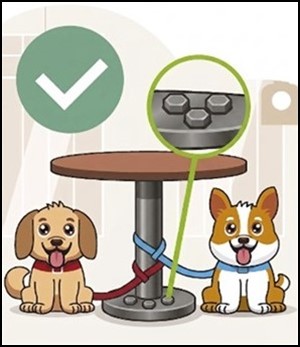
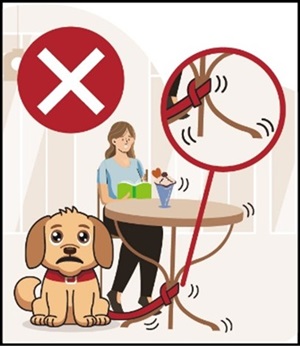
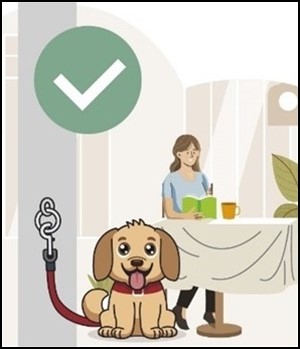
Furthermore, if a customer wishes to securely tie the dog to a fixed structure, that structure must be fixed to the floor or wall. Movable items such as chairs or dining tables are not suitable for this purpose. For example, it is appropriate to securely tie the dog to a table that is firmly fixed to the floor, or to a hook securely installed on a wall.

This requirement is to ensure that the dog remains under proper control while on the premises. Therefore, before allowing a customer with a dog to enter, restaurant staff should check whether the customer is an adult and whether the length of the leash complies with the legal requirement, among other things. If in doubt, staff should communicate clearly with the customer before entry to avoid any contravention.
Furthermore, if a customer wishes to securely tie the dog to a fixed structure, that structure must be fixed to the floor or wall. Movable items such as chairs or dining tables are not suitable for this purpose. For example, it is appropriate to securely tie the dog to a table that is firmly fixed to the floor, or to a hook securely installed on a wall.
If a dog is already placed in a pet stroller or a pet carrier, is the customer still required to control the dog in the manner prescribed by law?
Even if the dog is inside a pet carrier or stroller, the customer must still comply with the legal requirement of having the dog securely held on a leash by an adult or tied to a fixture, in order to address potential dangerous situations that may arise should the dog be startled or agitated by external stimuli.
What are "fighting dogs"?
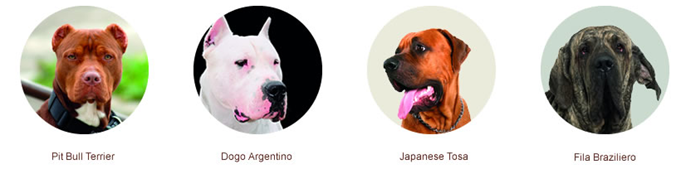
Pursuant to the Dangerous Dogs Regulation (Cap. 167D), Pit Bull Terrier, Dogo Argentino, Japanese Tosa, Fila Braziliero and their crossbreeds are classified as “fighting dogs”. Please refer to the photos below for your reference.
As of the end of 2025, there were approximately 20 fighting dogs in Hong Kong.
As of the end of 2025, there were approximately 20 fighting dogs in Hong Kong.
What are "known dangerous dogs"?
Under the Dangerous Dogs Regulation (Cap. 167D), a dog may be classified as a "known dangerous dog" if a magistrate determines it to be so under specific circumstances. This typically includes dogs that, without provocation, have attacked a person or a domestic animal, resulting in severe physical injury or death.
As of the end of 2025, there were approximately 20 "known dangerous dogs" in Hong Kong.
As of the end of 2025, there were approximately 20 "known dangerous dogs" in Hong Kong.
How can we distinguish between "fighting dogs" and "known dangerous dogs" as specified in the legislation?
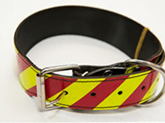
Under the Dangerous Dogs Regulation (Cap. 167D), 'fighting dogs' and dogs declared as 'known dangerous dogs' by a court must at all times wear a specific collar for identification purposes (see image below). In addition, such dogs must also wear a muzzle and be controlled with a leash not exceeding 1.5 metres in length. If in doubt about the situation, restaurant staff should request the customer with the dog to clearly state whether their dog is a 'fighting dog' or a 'known dangerous dog'.
Licencing Condition
Display of Designated Signage
How and where should the restaurant operator display the designated signage after the restaurant is granted permission to allow dogs to enter?
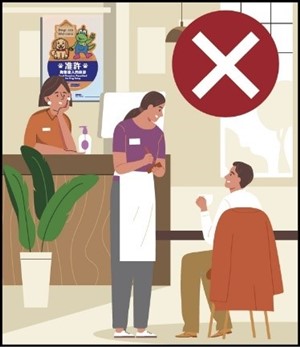
Restaurants granted permission by the FEHD shall display at all times an A3 size signage designated by the department in a conspicuous place near the main entrances of the premises and must be clearly visible to customers before they enter the restaurant. Displaying the designated signage at the cashier counter, or allowing it to be obstructed or covered by other objects, will be regarded as a breach of the licensing conditions. Furthermore, restaurant operators must comply with any instructions given by FEHD officers regarding the manner of displaying the designated signage.
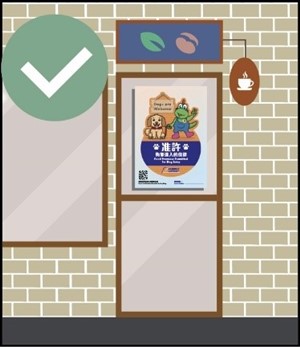
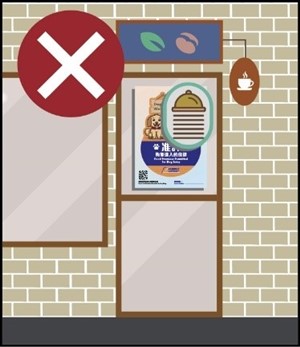
When is the restaurant operator required to display or remove the relevant signage?
From the effective date of the permission to allow dogs to enter the restaurant, the permitted restaurant must display the designated signage at all times, in accordance with the licensing conditions. Should the restaurant voluntarily surrender the permission, or if the permission is cancelled due to a breach of regulations, the licensee must immediately remove the designated signage upon the cancellation of such permission.
If a restaurant operator wishes to designate certain days or time slots during which dogs are not allowed to enter the restaurant, can they remove or put away the displayed signage displayed at the entrance?
Operators may decide to allow dogs to enter their premises only on certain days or during specific time slots. However, they must still display the designated signage in a conspicuous location at all main entrances at all times, in accordance with the licensing conditions. The signage must not be removed at any time. Operators should display additional notices explaining the arrangements for different time slots or days, so as to facilitate customer understanding and avoid unnecessary misunderstandings.
Operational Management
What should be noted if a restaurant has bar counter seating?
Bar counter seating is typically connected to the food counter or the area where food and drinks are prepared, and there is usually no permanent fixed partition reaching the ceiling separating the two.
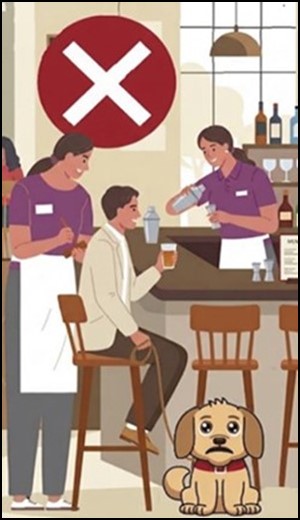
Allowing dogs to be present at such bar counter seating may increase food safety risks. Therefore, restaurant operators must prohibit customers with dogs from sitting at bar counter seating and should clearly communicate this arrangement to customers.
Allowing dogs to be present at such bar counter seating may increase food safety risks. Therefore, restaurant operators must prohibit customers with dogs from sitting at bar counter seating and should clearly communicate this arrangement to customers.
What should be noted if a restaurant has a buffet counter / salad bar?
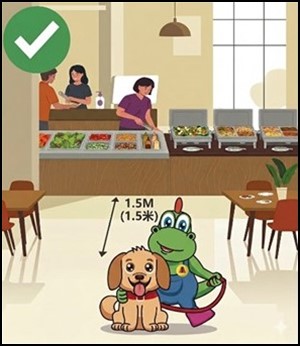
The buffet counter / salad bar is where food is displayed. Allowing dogs to be in close proximity may pose safety and food hygiene risks. Therefore, it must be ensured that dogs cannot reach the food. When assigning seats to customers with dogs, restaurant operators must ensure that dogs are not allowed within 1.5 metres of the buffet counter / salad bar.
Under the licensing conditions, restaurants are prohibited from heating food at the table. However, if electric heating or small heating devices such as alcohol burners are used instead of traditional gas stoves, would such methods be exempt from this restriction? Are there any exceptions?
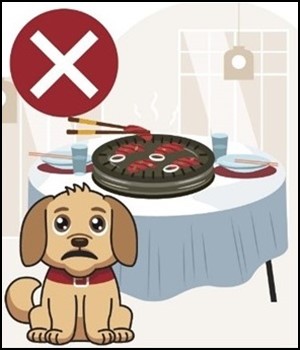
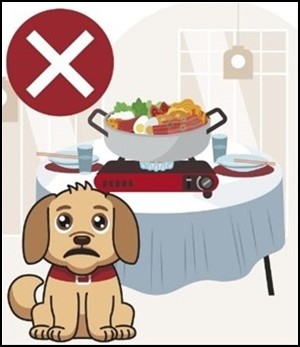
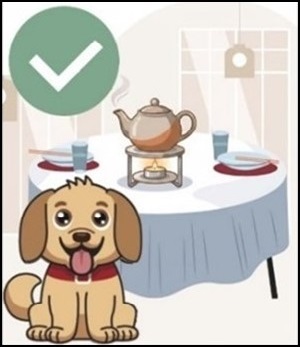
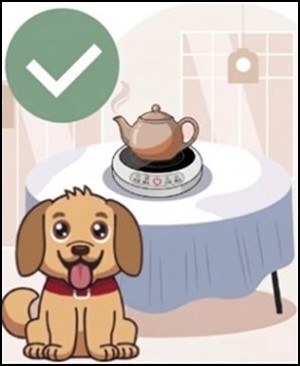
The prohibition on heating food at the table is intended to ensure the safety of customers, staff, and animals. Therefore, both open-flame heating and electric heating are prohibited. Beverage warming devices used by some restaurants, such as small candles or electric coasters used in coffee shops and Chinese teahouses, are not subject to this restriction.
If a restaurant has designated a portion of its premises as a "dog-friendly area," can food be heated at tables in the "non-dog-friendly area"?
No. For safety reasons, the licensing conditions that allow dogs to enter the restaurant apply to the entire area of the approved premises. This is to minimise the risk of injury to restaurant staff, customers, and dogs in the event of accidents such as spilled hot food or overturned heating appliances during any unforeseen circumstances.
Cancellation of Permission
Can a restaurant that has been granted permission to allow dogs to enter voluntarily cancel the permission?
Yes. A permitted restaurant may apply to the Department in writing. The Department will issue the permission for cancellation as early as four working days after receipt of the application. Once the permission is cancelled, the restaurant must immediately remove the designated signage displayed at the conspicuous location of the entrances.
What are the penalties if an approved restaurant breaches the licensing conditions or dog-related legislation?
If a permitted restaurant is issued with three warning letters within a 12-month period for breaching one or more of the licensing conditions or statutory requirements governing the admission of dogs into restaurants, its permission for dogs to enter may be cancelled. The restaurant will not be accepted to re-apply for such permission for a period of one year.
Additionally, if a restaurant is prosecuted for contravening the Public Health and Municipal Services Ordinance (Cap. 132) or its subsidiary legislation (including legislation relating to the admission of dogs into restaurants) and accumulates sufficient demerit points due to convictions within a 12-month period, its food business license may be suspended or cancelled in accordance with the FEHD’s existing Demerit Points System.
Additionally, if a restaurant is prosecuted for contravening the Public Health and Municipal Services Ordinance (Cap. 132) or its subsidiary legislation (including legislation relating to the admission of dogs into restaurants) and accumulates sufficient demerit points due to convictions within a 12-month period, its food business license may be suspended or cancelled in accordance with the FEHD’s existing Demerit Points System.
Serving Food to Dogs
Are restaurants permitted to provide food for dogs?
To ensure food safety and environmental hygiene, the licensing conditions stipulate that no cooking or preparation of dog food on the premises is allowed. This prohibition covers heating or reheating processes. Restaurants may provide or sell pre-packaged, ready-to-eat dog food that requires no further processing, such as dry kibble, vacuum-packed dog food, and canned dog food. However, they must not heat or reheat such food, including by using hot water or a microwave oven.
Are bread and cakes considered "pre-packaged dry dog food"?
Pre-packaged dry dog food generally refers to items such as dog biscuits, freeze-dried meat strips or pellets, and freeze-dried fruits or vegetables. It does not include bread or cakes.
Can pre-packaged dry dog food, vacuum-packed pet food, or canned dog food be heated?
No. If restaurant staff provide or sell processed dog food to customers, for instance, by removing the packaging and heating the food, it constitutes a breach of the licensing conditions.
Are restaurants allowed to provide facilities within the seating area for customers to heat dog food themselves?
The licensing conditions do not prohibit the provision of facilities on restaurant premises for customers to heat dog food themselves. If such facilities are provided, clear usage guidelines should be set out to ensure safety and environmental hygiene.
Can restaurants sell items related to facilitating dogs' entry into the premises, such as pee pads, leashes, muzzles, etc.?
Under normal circumstances, as long as food safety and environmental hygiene are not affected, the FEHD does not prohibit restaurants from selling small merchandise. Permitted restaurants may sell pee pads, leashes, muzzles, and similar items.
Management and Control of Dogs
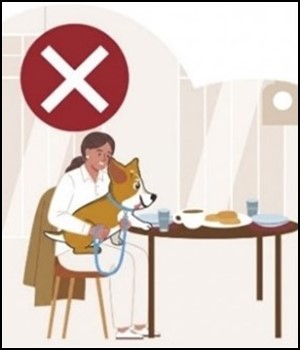
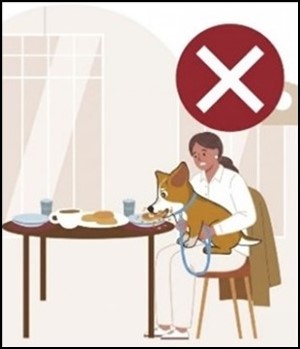
Dogs are not allowed to be on dining tables, but can they be held or seated on dining chairs and still come into contact with the table?
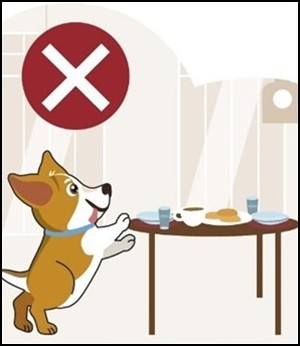
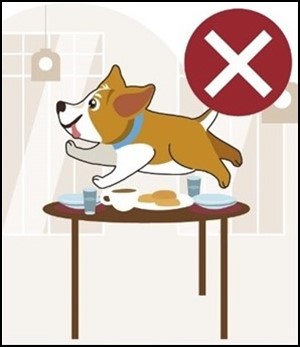
According to the licensing conditions, no dog shall be allowed on any dining table. This licensing condition is based on safety considerations and aims to protect the safety of restaurant staff, customers, and dogs, preventing accidents in which a dog, suddenly startled or excited, could knock over tabletop appliances, hot soup, or hot oil.
As to whether dogs are allowed to be on dining chairs, given that individual restaurants may have different premises, environments, and operations, restaurant operators may refer to the key factors set out in the coming "Guideline on Good Practices and Behaviour" and make their own arrangements based on actual circumstances.
It must be noted that regardless of whether a dog is held or seated on a dining chair, it must not come into contact with the dining table top, and dog food must not be placed on the dining table for the dog to consume.
As to whether dogs are allowed to be on dining chairs, given that individual restaurants may have different premises, environments, and operations, restaurant operators may refer to the key factors set out in the coming "Guideline on Good Practices and Behaviour" and make their own arrangements based on actual circumstances.
It must be noted that regardless of whether a dog is held or seated on a dining chair, it must not come into contact with the dining table top, and dog food must not be placed on the dining table for the dog to consume.
Dogs are not allowed to use "reusable utensils" What utensils can dogs use to eat in a restaurant?
To protect public health and ensure that humans and dogs do not share tableware, the licensing conditions stipulated that reusable utensils shall not be provided to dogs on the premises that are intended for human use. Restaurants may provide or sell single-use non-plastic utensils or crockery for dogs to use. Dog owners may also bring their own tableware for their dogs to use.
If a dog defecates or urinates inside a restaurant, who is responsible for cleaning it up? Can the restaurant charge a cleaning fee for this?
At present, the Food Business Regulation and licensing conditions require that restaurants maintain cleanliness and hygiene at all times to ensure food safety and environmental hygiene. This is a fundamental responsibility of restaurant operators. On this premise, restaurant operators may formulate arrangements for cleaning up dog waste based on their own circumstances. For example, if a restaurant intends to charge a cleaning fee to customers who soil the premises, the operator must clearly inform customers of this in advance to avoid disputes. Even if the customer does not clean up the dog waste themselves, the restaurant must clean it up immediately; failure to do so constitutes a breach of the licensing conditions. Depending on the circumstances, the restaurant may also be in contravention of food business regulations for failing to keep the premises clean.
When making these arrangements, restaurant operators should also refer to the coming "Guideline on Good Practices and Behaviour" issued by the FEHD, which sets out factors to consider, such as providing designated rubbish bins for customers or staff to dispose of dog waste. It should be noted, however, that such rubbish bins must not be placed inside food rooms.
When making these arrangements, restaurant operators should also refer to the coming "Guideline on Good Practices and Behaviour" issued by the FEHD, which sets out factors to consider, such as providing designated rubbish bins for customers or staff to dispose of dog waste. It should be noted, however, that such rubbish bins must not be placed inside food rooms.
Incident Handling
In the event of an incident where a dog bites a person or another animal, who will be liable? Is the restaurant required to report it to the FEHD?
Dog owners bear the responsibility to restrict and control their dogs. Under the Rabies Ordinance (Cap. 421), if a dog is found in any public place (including restaurants) without being on a leash or otherwise under control and bites a person, the keeper of the dog is guilty of an offense and liable to a level 3 fine, unless they can prove that all reasonable measures were taken to prevent the biting or that the dog was intentionally provoked. Furthermore, the keeper must notify the nearest police station without delay and detain the dog in a secure manner, isolated from other animals, for a period specified by the police; failure to do so is an offence liable to a level 3 fine.
The FEHD has stipulated in its licensing conditions that if a dog causes injury to any person on the premises and the matter is reported to the police, the licensee must report the case to the FEHD using the designated form within two working days of the occurrence. Restaurant operators may also refer to the coming "Guideline on Good Practices and Behaviour" to formulate response plans, which include measures such as consoling affected customers and reminding dog owners of their legal responsibilities.
The FEHD has stipulated in its licensing conditions that if a dog causes injury to any person on the premises and the matter is reported to the police, the licensee must report the case to the FEHD using the designated form within two working days of the occurrence. Restaurant operators may also refer to the coming "Guideline on Good Practices and Behaviour" to formulate response plans, which include measures such as consoling affected customers and reminding dog owners of their legal responsibilities.
For full text of the Frequently Asked Questions, please refer to the document below.

Enquiry
For any questions, please contact our hotline at 2867 5912 or 2867 2836.